Camiel Schroeder
Seventy Billion
It was 3 AM in a battery cage facility in New South Wales, and he had been crouched in the darkness for six hours, his camera recording the rows of cages that stretched so far into the shadows that the building seemed to have no end. The smell had long since stopped registering as a distinct sensation and had become instead a constant pressure in his throat, a thickness in the air that made every breath feel labored. But it was not the ammonia that broke through his professional detachment. It was the sound.
In the cage directly in front of him, a hen was dying. Her body had become wedged between the wire bars and the feeder trough, her neck twisted at an angle that made it clear she had been struggling for hours, perhaps days. Her wings were splayed out at unnatural angles, the feathers worn away to raw skin from constant rubbing against the cage. Her feet, curled around the wire floor, had overgrown nails that had grown through the mesh and back into her own flesh. She was making a sound Delforce had never heard from a chicken before: a wet, rattling wheeze that seemed to come from deep in her chest. In the cages around her, other hens pecked mechanically at feed, their movements automatic, their eyes dull. Some had bare patches of skin where feathers should have been. Others had feet so damaged from standing on wire their entire lives that they could barely grip the floor. One hen, her beak severed so short that her tongue protruded slightly, was pecking at the corpse of another bird that had died days earlier and had simply been left where it fell.
Delforce filmed for another forty minutes before the dying hen finally stopped moving. In the morning, he would learn that in facilities like this one, mortality checks happen every few days at most. Dead birds are simply left to decompose among the living until someone makes rounds.
The surviving hens walk over them, sleep next to them, lay eggs beside them.
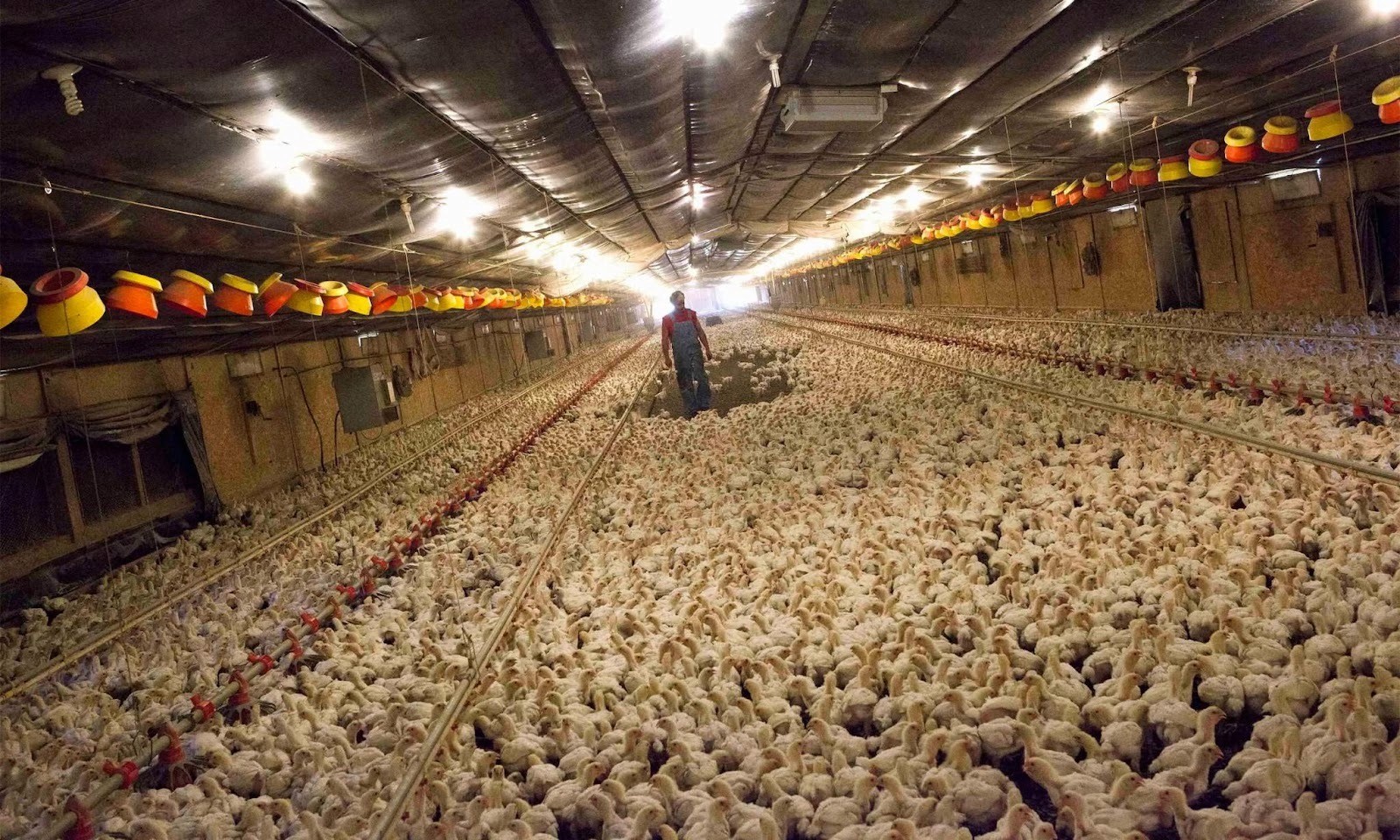
The majority of pigs and poultry are reared on intensive farms, according the campaign group Compassion in World Farming.
Photograph courtesy of Randall Hill/Reuters
He was working on Dominion, a 2018 documentary that would eventually compile footage from over 100 Australian farms and slaughterhouses. The project took years. It required Delforce and his team to enter facilities repeatedly, often at night, always illegally. They filmed inside pig facilities where pregnant sows lay in metal crates so narrow the animals could not turn around, their bodies pressed against steel bars, their snouts rubbing against the concrete until open sores formed. They documented gestation crates where pigs had gnawed the metal bars so obsessively that their teeth were broken and their gums bled. They recorded the sounds of piglets screaming as their tails were cut off with pliers, their teeth clipped with wire cutters, their testicles cut out with scalpels. All without anesthesia. All while fully conscious.
All before they were three days old.
In dairy facilities, they filmed calves being torn from their mothers within minutes of birth. The footage showed mother cows following the workers who dragged their newborns away, bellowing with an intensity that requires no interpretation. One cow, filmed through a gap in a barn wall, spent three days standing at the gate where her calf had been taken, calling continuously, her voice growing hoarse, her body visibly trembling. When she finally stopped calling, she simply stood motionless, staring at the empty space. The farm's own records, later obtained, showed she had given birth to seven calves over seven years. Every single one had been taken within a day. Every single time, she had called for them until her voice gave out.
But maternal bonds are probably just instinct. Nothing meaningful there.
The slaughterhouse footage was worse. Delforce had thought he was prepared. He had researched the mechanics of industrial slaughter, studied the equipment, read the welfare guidelines. But seeing a captive-bolt gun malfunction and watching a cow shot four times in the head while fully conscious, her eyes wide, her legs kicking, blood pouring from the wounds as workers reloaded and fired again– he couldn’t.
He filmed chickens hanging upside down on shackle lines, some with broken legs from rough handling during catching, flapping desperately as they moved toward the electrified water bath that was supposed to stun them. Many were the wrong size for the bath depth and missed the water entirely, arriving at the automated throat-cutting blade fully conscious. He watched them spasm as the blade struck. Some bled out before reaching the scalding tank. Others did not. The scalding tank is set to 125.6-134.6 degrees Fahrenheit; hot enough to loosen feathers, but not hot enough to kill instantly. Drowned and scalded to death simultaneously, a process that takes several minutes.
Efficiency has its costs.
In pig slaughterhouses, he filmed CO₂ stunning chambers from an access panel on the upper level, looking down as groups of eight to ten pigs were loaded into metal gondolas and lowered into pits filled with carbon dioxide. The gas is heavier than air and fills the chamber from the bottom up. The pigs entered the gas slowly, breathing normally at first, then beginning to show distress as the CO₂ concentration increased. Their breathing became rapid, then labored. They began squealing, not the normal pig vocalization but a high-pitched, desperate scream that occurred in waves as they tried to escape. They climbed over each other, bit at the metal walls, thrashed against the gondola bars. Delforce filmed as a pig remained conscious and struggling for over ninety seconds, its screams echoing in the chamber even as the other pigs in its group had stopped moving.
The workers he occasionally encountered seemed neither cruel nor kind. They were tired. They worked long shifts in dangerous conditions for low pay. Many were immigrants or refugees with limited other employment options. They moved through their tasks with the mechanical efficiency of people who had long since stopped seeing animals and saw only units to be processed. Delforce watched one worker in a chicken processing plant shackle birds so quickly that the action took less than three seconds per bird. The worker shackled approximately 1,200 birds per hour. In a ten-hour shift, that was 12,000 birds handled by one person. The facility processed 175,000 birds per day.
The psychological toll on the filmmakers was severe and well-documented. Many reported symptoms consistent with complex PTSD: intrusive memories, nightmares, difficulty eating, social withdrawal. Several sought therapy. Some found they could no longer watch the footage they had captured without experiencing panic attacks. Delforce described lying awake at night replaying scenes, unable to stop seeing the faces of individual animals, remembering their sounds. One crew member on Earthlings quit midway through the project, saying he could not continue filming slaughterhouses because he was having suicidal thoughts. Another developed severe anxiety that required medication.
But they also described a sense of moral obligation. They had witnessed something the vast majority of humans would never see. They had documented evidence of a system operating at incomprehensible scale, causing suffering so vast it defied normal moral categories, and doing so largely invisibly, hidden behind walls and legal barriers. They had, in effect, gone into the places society collectively agreed not to look at, and they had brought back proof of what was happening there.
The question was whether anyone would be willing to see it.
Chris Delforce, of Farm Transparency Project, being arrested at a slaughterhouse in 2023.
Image Courtesy of The Saturday Paper
Dear reader, I know this is hard to read. It should be hard to read. It's infinitely harder to experience. Keep reading. You need to know what happens behind the walls you're not supposed to see behind.
The Scale Of It All
Every facility documented in Dominion represents a single data point in a system of almost incomprehensible scale. The numbers are so large they cease to feel like numbers and become instead abstract symbols that the mind cannot fully process. But they are not abstractions. They are individuals. And understanding the scope of what we have built requires grappling with the mathematics of suffering.
Seventy billion land animals are killed for food every year.
Seventy. Billion.
To put it in perspective: there are approximately eight billion humans alive today. The number of land animals we kill for food each year is nearly ten times the entire human population of Earth. Imagine every person you have ever met, every person you have seen on a street or in a photograph, every loved one and every complete stranger that walks this earth. Now imagine that person slaughtered. Stabbed, flayed, boiled, skinned alive. Every single one of them. Do that 10 times. Now do it again next year, every single year.
Maybe that feels a bit hard to grasp. Let me try another approach.
The total number of humans who have died in all wars in recorded history is estimated at roughly one billion people. That includes every battle, every siege, every genocide, every soldier and civilian killed in conflict from the beginning of written human history to the present day.
We kill more land animals for food every five days than have died in all human wars combined across thousands of years.
The Holocaust, rightly considered one of the greatest moral atrocities in human history, killed approximately six million Jews and eleven million people total over a period of years. Factory farming kills more land animals than that every four hours. By the time you wake up tomorrow morning, more animals will have been slaughtered than died in the entire Holocaust.
The Black Death, the deadliest pandemic in human history, killed an estimated 75-200 million people over several years in the 14th century. Factory farming surpasses the upper estimate of Black Death casualties every single day.
Every minute, more animals die than were killed in the atomic bombing of Hiroshima. Every hour, more animals are slaughtered than all the people who died in the Rwandan genocide. Every three seconds, more land animals are killed for food than died in the September 11 attacks. The comparisons become numbing after a while, but they are necessary because the scope is otherwise impossible to grasp.
And we have not even counted fish yet.
When you include fish and other aquatic creatures, the numbers enter a different realm entirely. Conservative estimates suggest that between one and three trillion fish are killed annually for food. That number is so large that most people have no intuitive sense of what it means. If you tried to count to one trillion, counting one number per second, working continuously without sleep, it would take you approximately 31 thousand years. That is longer than the entire span of recorded human history. And we kill somewhere between one and three times that many fish every single year.
There are approximately 5,000 stars visible to the naked eye from Earth. Now imagine replacing each of those stars with 200 million fish. That gets you to one trillion. Now imagine all of those fish pulled from the water, gasping, their gills heaving uselessly in the air, dying slowly from asphyxiation. Now imagine it happening again next year. And the year after that. And the year after that.
The sheer mathematics of this suffering becomes almost cosmological in scale. If we assume, conservatively, that each animal killed in this system experiences even just one hour of significant suffering (during transport, holding, or slaughter), we are talking about 70 billion hours of suffering for land animals alone. Roughly eight million years of continuous agony, every single year. If we include fish at the lower estimate of one trillion, we are adding another one trillion hours. 114 million years of continuous suffering, annually.
"They're Too Stupid to Feel Most of It”
This is perhaps the most common defense of factory farming, and it deserves to be confronted directly because it is both scientifically false and morally convenient. The argument goes: chickens are basically vegetables, pigs don't have the intelligence to really suffer, fish are too primitive to feel pain, cows don't understand what's happening to them. The implication is always the same: these animals are fundamentally different from us, less intelligent, less aware, and therefore their suffering is diminished, less real, not morally significant.
Let's be brutally clear: this is nonsense. And the evidence proving it nonsense is so overwhelming that continuing to believe it requires active effort.
Pain is not an intellectual achievement. You don't need to solve calculus to feel agony when your body is damaged. Pain is a biological alarm system that evolved hundreds of millions of years ago to help organisms avoid harm. The basic machinery, the fundamental circuitry, is essentially the same across all vertebrates. You need three things to feel pain: receptors that
detect tissue damage, nerves that transmit the signal, and a brain that processes it. Every animal we factory farm has all three. This is not controversial science. This is basic neurobiology.
Chickens
Chickens have nociceptors (pain receptors), just like you. They have neural pathways that carry pain signals to their brains, just like you. They have brain regions that process those signals, just like you. When you sear a chicken's beak with a hot blade, she doesn't just flinch and forget about it. Brain scans show sustained activity in pain-processing regions for days afterward. She stops eating because pressing her mutilated beak against food hurts. She shakes her head repeatedly, the same way you would if someone took a blowtorch to your face. Some chickens develop chronic pain in the beak tissue that lasts for months, comparable to phantom limb pain in human amputees.
Chickens also remember pain. If you repeatedly catch chickens roughly in one corner of a barn, they'll avoid that corner in the future, even when there's food there. They learn. They remember. They alter their behavior to avoid suffering. This requires memory, learning, and the formation of negative associations. In other words: consciousness.
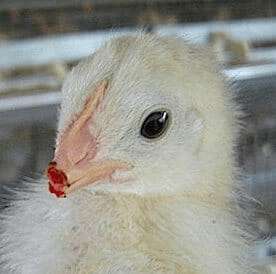
Debeaking.
Image courtesy of Free From Harm
Pigs
Pigs make the "too stupid to suffer" argument look even more ridiculous because their cognitive abilities are well-documented and impressive. They can solve complex puzzles. They can learn symbolic representations. They can use mirrors to find hidden food. They show empathy, distress when other pigs are suffering, and joy when reunited with companions. Their intelligence is comparable to dogs and three-year-old children. So when someone tells you pigs
are too stupid to really suffer, they're either lying or ignorant.
Watch what happens when you castrate a piglet without anesthesia. He screams. Not a normal pig sound, a piercing, sustained scream. His heart rate spikes to over 200 beats per minute. His stress hormones surge. He thrashes violently, trying to escape. Some piglets go into shock.
Does that look like an animal that's too stupid to feel pain? Or does it look like an animal experiencing exactly what you would experience if someone cut into your genitals with a blade while you were fully conscious?
The suffering doesn't stop after the acute pain. Pigs confined in gestation crates, metal cages so narrow they cannot turn around, develop stereotypies: repetitive, purposeless behaviors that only emerge under conditions of severe psychological distress. They bite metal bars for hours until their teeth break and their gums bleed. They chew empty air compulsively, a behavior with no function, performed because they're losing their minds. They press their snouts against bars until open sores form. These are not normal pig behaviors. These are signs of severe mental breakdown, the same kinds of behaviors you see in humans with untreated schizophrenia or in prisoners kept in solitary confinement.
Some pigs in gestation crates become nearly catatonic. They lie motionless for most of the day, barely responsive to their surroundings, showing little interest in food. Researchers call this "learned helplessness," a state of depression that occurs when an animal is subjected to inescapable suffering for so long that it gives up trying to escape. This is not reduced suffering. This is suffering so extreme the animal has lost hope.
Cows
Cows form friendships. They have best friends. Research shows they prefer spending time with specific individuals, their stress hormones are lower when paired with preferred companions, and they show distress when separated from them. They're social animals with emotional lives.
When you take a calf from her mother, both show immediate and extreme distress. The mother bellows, a loud, sustained vocalization that's distinct from normal cow sounds. She doesn't do this for a few minutes. She does it for hours. Some cows call continuously for five or more hours, their voices growing hoarse. They pace along fences, searching for their calves. They stop eating. Their stress hormones remain elevated for days.
The calf calls back, crying for his mother continuously for the first 24 to 48 hours. He paces in his small hutch, trying to escape. Many calves develop diarrhea from the stress. Some become lethargic and withdrawn, showing behavioral signs of depression.
This happens every time a dairy cow gives birth. Every single time. Her calf is taken within hours, sometimes within minutes. She calls for him. He calls for her. Eventually they both stop calling, not because they've stopped caring, but because calling achieves nothing.
The physiological markers are identical to what you would see if you separated a human mother from her infant: elevated stress hormones, elevated heart rate, reduced immune function, loss
of appetite. The mechanisms are the same because maternal bonding evolved once in mammals and is conserved across species. A cow doesn't need to understand the economics of dairy farming to feel the loss of her child. She just needs to be a mother whose baby has been taken.
Suggesting that cows are too stupid to really suffer from this requires believing that maternal bonds, one of the most fundamental mammalian experiences, somehow don't count when the mother isn't human.
Fish
Fish are where people really dig in with the "too stupid to suffer" argument, because fish seem alien. They don't have faces we recognize. They don't vocalize in ways we can hear. They live underwater. It's easy to look at a fish and see something mechanical.
Here's what actually happens when you pull a fish from the water.
The fish cannot breathe. Gills extract oxygen from water, not air. So the fish begins to suffocate. This is not a peaceful loss of consciousness. Suffocation triggers panic responses in vertebrates, including fish. The fish's gills open and close rapidly, desperately trying to pull in oxygen that isn't there. Its body thrashes. Its mouth gapes. These are not reflexes. Brain imaging shows increased activity in pain-processing regions of the fish brain during asphyxiation.
This process takes 15 to 30 minutes for most species. Some fish remain conscious for over an hour, their gills heaving, their mouths opening and closing, until finally they die from oxygen
deprivation. If you've ever choked, ever had the wind knocked out of you, ever felt that instant of panic when you couldn't breathe, imagine that lasting not for seconds but for 15 minutes. That's what the fish experiences.
"But how do we know they actually feel it?" Because we tested it. Researchers injected bee venom and acetic acid into fish lips to cause pain, then watched what happened. The fish didn't just swim away. They rubbed their lips against tank walls (pain-relief behavior). They rocked back and forth. They stopped eating for hours. Their stress hormones spiked. When researchers added pain medication to the water, the injured fish actively sought it out, spending time in the medicated water even though it meant leaving their preferred areas. They were choosing pain relief. That's not a reflex. That's a conscious choice.
The Mathematics of Dismissal
Let's say, for the sake of argument, that you're right. Let's say chickens, pigs, cows, and fish only experience 10% of the pain and suffering that a human would experience in the same situation. Let's be wildly conservative and say their subjective experience of suffering is dramatically reduced compared to ours.
Now do the math.
Seventy billion land animals are killed for food every year. If each one experiences even 10% of what a human would experience, that's seven billion human-equivalent suffering-years annually, just from land animals. Add fish at the lower estimate of one trillion per year, each experiencing 10% of human suffering for even just 15 minutes of dying, and you get 28.5 million years of human-equivalent suffering. Every single year. Even if you assume their suffering is dramatically
less than ours, the sheer numbers dwarf every human atrocity in history.
Pain is pain. A pig screaming while being castrated isn't performing for your sympathy. She's experiencing agony. A cow bellowing for her calf isn't confused about economics. She's grieving. A chicken with a mutilated beak isn't failing to understand the concept of pain. She's in pain and avoiding behaviors that make it worse. A fish suffocating on a deck isn't too primitive to suffer. He's dying slowly and he's conscious for most of it.
The "too stupid to suffer" argument fails on the science. But more importantly, it fails morally. Because even if you genuinely believed these animals experienced less suffering than humans, "less suffering" is not the same as "no suffering" or "suffering that doesn't matter." We have built a system that produces suffering on a scale almost beyond comprehension. The fact that the victims can't verbally explain their pain to us doesn't make it less real. It just makes it easier to ignore.
And we have been ignoring it for a very long time.
What Standard Practice Looks Like
A Life in Wire
To understand what seventy billion means, you must start with one. Start with a single hen.
She hatches in an industrial hatchery, one of approximately 50,000 eggs incubated simultaneously in climate-controlled warehouses. She has been selectively bred over generations for a single trait: the ability to produce more than 300 eggs per year, more than ten times what her ancestors would have laid in the wild. This breeding has consequences. Her skeleton is thin and brittle, prone to fractures. Her reproductive system is chronically strained. But she does not know this yet. She is simply alive, emerging wet and disoriented from her shell, surrounded by thousands of other newly hatched chicks.
If she is male, her life ends within hours. Male chicks cannot lay eggs and are the wrong breed for meat production (egg-laying breeds have been selected for egg production, not meat yield, making them economically worthless for meat). They are sorted on a conveyor belt by workers who pick them up, glance at them, and toss them either left (female) or right (male). The males drop into large containers. Some hatcheries use macerators, industrial grinders that kill instantly by pulverizing the chicks at high speed. Others use CO₂ gas chambers, where chicks are sealed in containers and suffocated over several minutes. Both are considered humane by industry standards. Approximately 6-7 billion male chicks are killed this way globally each year, most within 24 hours of hatching.
This happens because they're the wrong sex. That's it. That's the entire reason. They cannot produce eggs, so they're worthless, so they're ground up or gassed. All so you can buy a dozen eggs for $3.99.
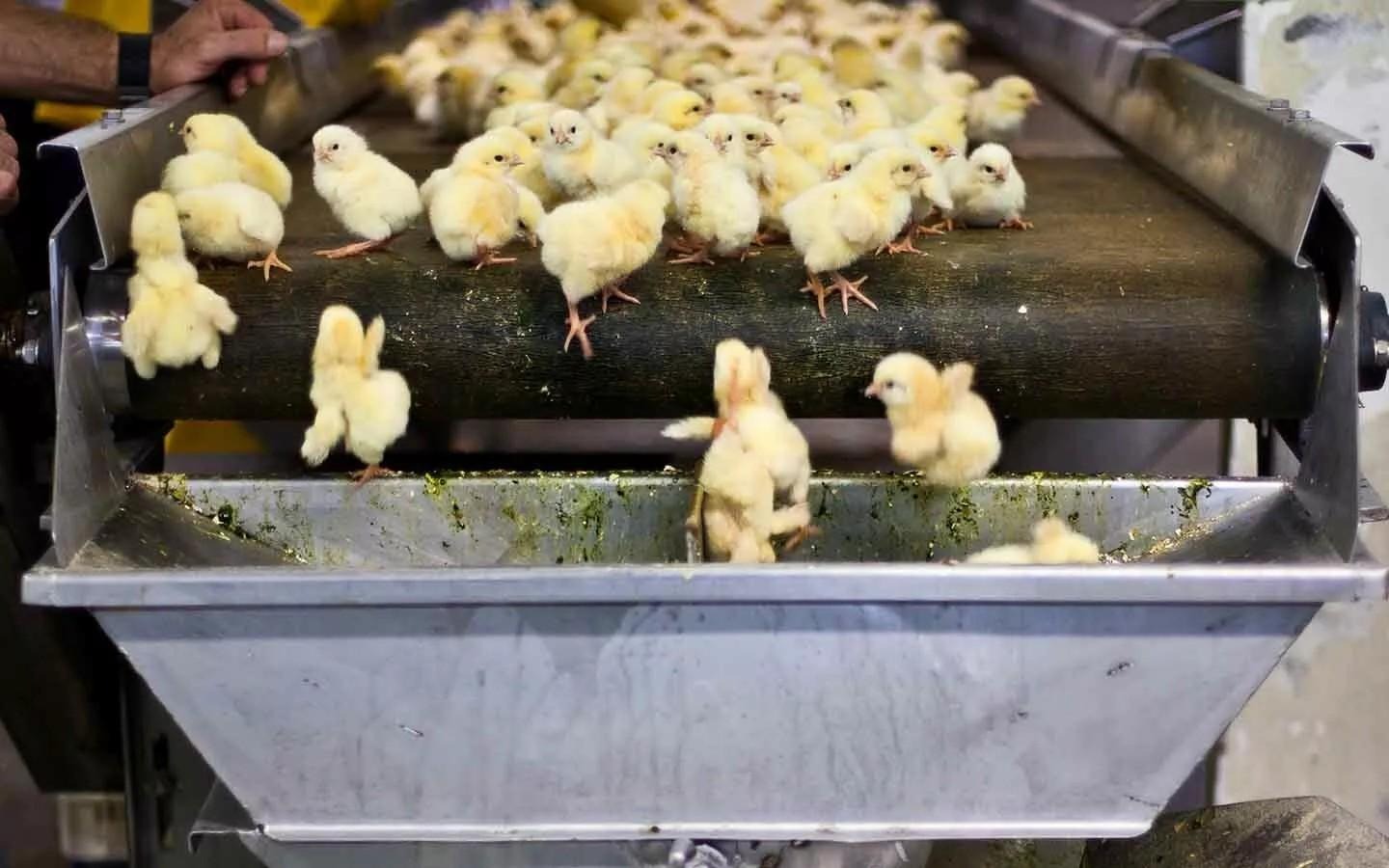
Billions of baby birds face death on the day they are born simply because their lives are not profitable.
Image Courtesy of Animal Equity
Our hen is female, so she survives this initial selection. She is moved on a conveyor belt to a debeaking machine. This machine uses a hot blade to cut off one-third to one-half of her beak. The procedure is performed without anesthesia.
Let me be clear about what this means. The beak contains sensory receptors and nerve endings similar to those in human fingertips. Imagine someone taking a hot blade and cutting off half your finger, no anesthesia, no pain relief. That's what's happening to this chick. Research shows immediate spikes in stress hormones and behavioral changes consistent with severe pain responses. Many chicks stop eating temporarily after debeaking because pressing their mutilated beaks against feeders hurts too much. Some develop chronic pain in the beak tissue that persists for months or years.
The procedure is not performed out of cruelty but out of economic necessity. In the crowded conditions of battery cages, hens will peck each other compulsively, sometimes injuring or killing cage mates. Rather than reducing the crowding, the industry removes the beaks. See how that works? Problem solved.
At around 18 weeks old, when she reaches sexual maturity, our hen is transported to an
egg-laying facility. The facility is a windowless metal warehouse approximately 150 meters long and 40 meters wide. Inside, battery cages are stacked four to six levels high in rows that stretch the length of the building. Each cage is approximately 40-60 centimeters wide and 45 centimeters deep. Our hen shares her cage with five to seven other hens. Each hen has approximately 430-560 square centimeters of floor space: less than the size of a standard sheet of printer paper. The cage is 40 centimeters tall. A hen needs approximately 70 centimeters of horizontal space to spread her wings. She will never spread her wings again.
The floor of the cage is made of wire mesh angled slightly downward so that eggs roll to the front for collection. Wire flooring is efficient because waste falls through, but will tear at our hen.
The hen's feet, designed for scratching earth and perching on branches, are not adapted to standing on wire continuously. Over time, her toe pads develop lesions and ulcers. Her claws overgrow and sometimes curl through the wire mesh back into her own flesh. She cannot perch, dust-bathe, forage, nest, or engage in virtually any natural behavior. She can stand, she can sit, and she can move her head to reach the feeder and water nipple. That is the entirety of her possible actions for the next 18-24 months.
Battery cages, kept dark beyond range of the camera flashgun.
Image Courtesy of Ethelred
The building houses approximately 100,000 hens across all cages. The air is thick with ammonia from accumulated feces and urine, because the ventilation system cannot keep up with the concentration of waste from so many birds in such a small space. Ammonia levels in poorly ventilated battery cage facilities regularly exceed 50 parts per million (ppm). At 20 ppm, humans experience eye and throat irritation. At 50 ppm, permanent lung damage can occur.
The hens breathe this air continuously. Our hen will likely develop chronic respiratory symptoms within her first year.
The lighting is artificial and controlled to maximize egg production. Some facilities use 23 hours of light per day, giving hens almost no dark period for rest, as continuous light stimulates egg production. The hen's circadian rhythm is destroyed. She exists in a state of constant artificial day.
Her body begins producing eggs. One every day, sometimes more. Her bones begin to weaken. The calcium required to produce 300+ eggs per year is leached from her skeleton at a rate her diet cannot fully replace. Studies show that between 20-30% of hens in battery cages have
broken bones before they reach slaughter. Most breaks occur in the sternum and ribs from pressing against cage wires or from laying eggs in cramped positions. Some breaks occur in wings and legs from catching and transport. Our hen will likely suffer multiple bone fractures before she is two years old. She will receive no veterinary care. The economics do not support treating individual hens in facilities with hundreds of thousands of birds.
The behavioral consequences of confinement are severe. Hens in battery cages develop repetitive, purposeless behaviors indicating psychological distress. Some peck obsessively at cage bars. Some pull out their own feathers. The bird in the cage next to our hen has pecked herself nearly bald, her skin exposed and raw. Another hen in a neighboring cage has become nearly catatonic, standing motionless for hours except when reaching for food or water. These are signs of severe psychological suffering, comparable to the behaviors seen in humans with profound depression or anxiety disorders.
Approximately 5-10% of hens die before reaching slaughter age. Workers check for dead birds every few days. Until then, corpses remain in the cages with living birds. Our hen spends two weeks with a dead hen in her cage, the body decomposing slowly, before workers remove it during their rounds.
After 18-24 months, her egg production declines to a point where she is no longer profitable. She is now classified as "spent". Industry terminology for hens whose productive life is over.
She is transported to a slaughterhouse in a truck with thousands of other spent hens. The journey takes several hours. She has no food or water. She is in severe pain from her broken wing, which is twisted awkwardly against the side of the transport crate. Many birds in the truck die during transport from stress, injury, or heat exhaustion. Our hen survives.
At the slaughterhouse, she is removed from the transport crate and shackled upside down by her legs on a moving conveyor line. The shackling is painful as her legs, designed for standing upright, are not meant to support her full body weight in an inverted position. The broken wing hangs down, the fractured bone grinding against nerve endings. She hangs on the line for several minutes as it moves through the facility.
The line carries her toward an electrified water bath designed to stun her unconscious before her throat is cut. But the bath is calibrated for birds of average size, and she is smaller than average (spent hens typically weigh less than younger birds). Her head does not make full contact with the electrified water. She receives a shock strong enough to be painful but not strong enough to render her unconscious. She is still fully aware as the line carries her forward to the automated throat-cutting blade.
The blade is designed to sever both carotid arteries and the jugular vein. But she is struggling, and her movements cause the blade to cut too shallow. It severs one artery but misses the other. She is bleeding heavily but not fast enough to lose consciousness before the next stage. The line carries her forward to the scalding tank.
The scalding tank is filled with water heated to 52-57 degrees Celsius, designed to loosen
feathers so they can be removed by mechanical pluckers. Birds are supposed to be dead before they reach this stage. Our hen is not. She is drowning and being scalded simultaneously, her lungs filling with water, her skin burning, her heart still beating. The process takes approximately 60-90 seconds before she finally loses consciousness and dies.
Too Intelligent for Their Own Good
Pigs are widely recognized as highly intelligent animals, with cognitive abilities comparable to dogs, dolphins, and three-year-old human children. They can solve complex problems, learn symbolic language, use mirrors to locate food, show empathy, and form deep social bonds. This intelligence makes their treatment in factory farms particularly cruel.
Follow one sow through her life.
She is born in a farrowing crate, one of 12 piglets. Her mother lies pressed against metal bars, unable to move freely, unable to turn around. Two of her siblings are crushed in the first week when their mother collapses from exhaustion. The sow hears their squeals but cannot understand what is happening. Not yet.
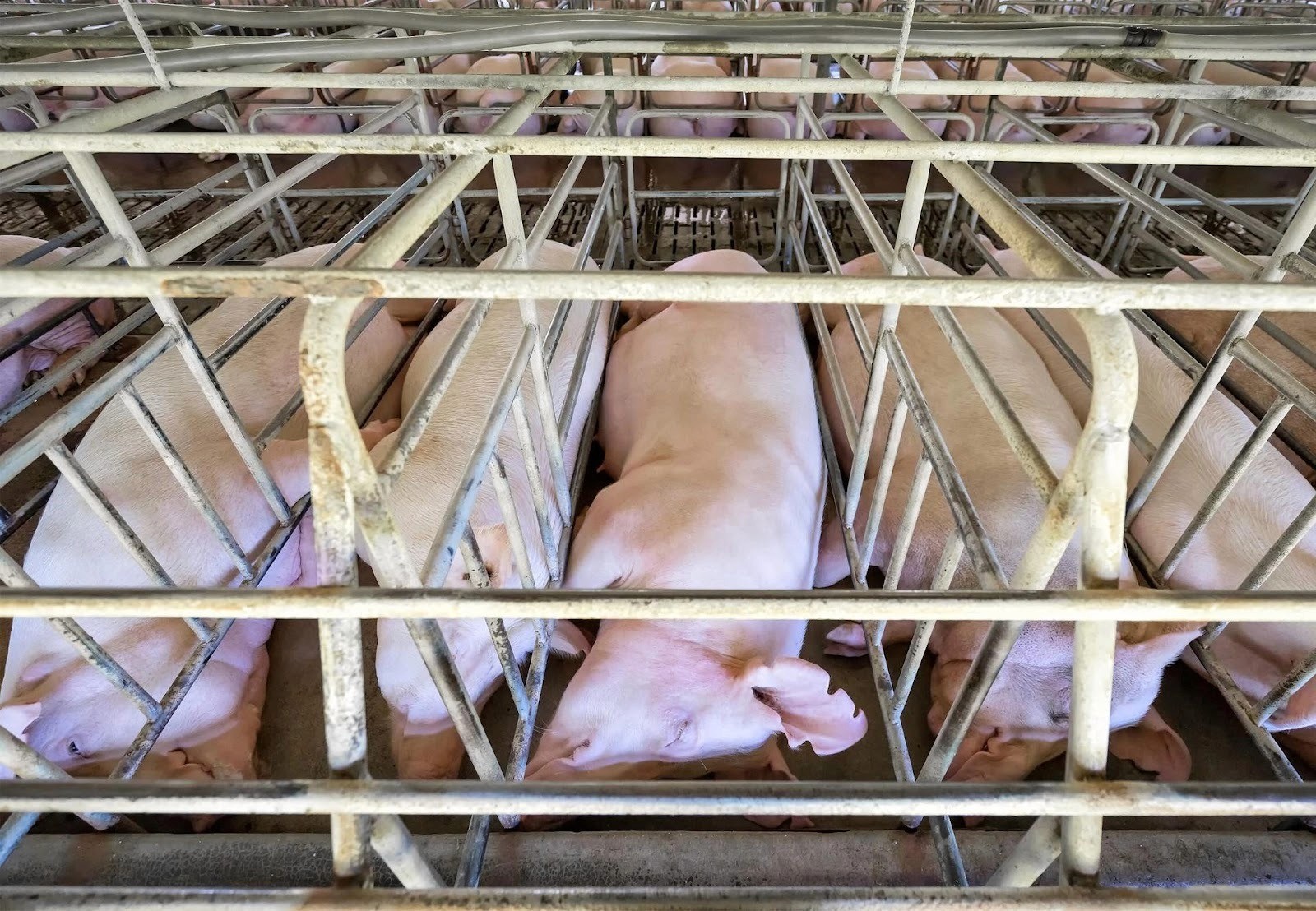
Sow stalls
Image Courtesy of Four Paws
When she is three days old, workers come. They grab her by her back legs and hold her upside down. She squeals, terrified, struggling. A worker uses pliers to cut off two-thirds of her tail. The pain is immediate and overwhelming. She screams, thrashes, convulses. Then they clip her teeth at the gum line. The exposed nerves send waves of pain through her jaw. She is placed back with her mother and siblings, shaking, the pain persisting for days. This happens to millions of piglets every single day. No anesthesia. No pain relief. Standard practice.
At three weeks old, she is weaned. In nature, she would nurse for 12 to 15 weeks. She is not ready. She cries continuously for days, searching for her mother. Her mother, in another part of the facility, is calling for her piglets. Neither can reach the other. The young pig develops diarrhea from the stress and dietary change. Some of her nursery mates die. Their bodies are removed during rounds.
She survives the nursery phase and is moved to a finishing pen. The pen houses dozens of pigs on a concrete floor. She has less than one square meter of space. There is nothing to do. No straw to root in, no objects to manipulate, no space to explore. Pigs in natural settings spend 70 to 80% of their waking hours foraging and exploring. In the finishing pen, there is nothing. She begins chewing on the bars of the pen. She presses her snout against walls. She is going insane from boredom and stress, though she does not have words for it. She only knows something is wrong, something is missing, something hurts that is not physical pain.
When she reaches approximately six months old and 130 kilograms, she is selected for breeding rather than slaughter. She is moved to a gestation facility.
She is placed in a gestation crate: a metal cage 60 centimeters wide and 200 centimeters long. Barely larger than her body. She tries to turn around. She cannot. She takes a step forward, then backward. That is the full extent of her movement. She can stand up. She can lie down.
That is all.
She does not understand why she cannot move. She tries again. And again. She presses against the bars. They do not give. Days pass. She begins biting the bars obsessively, for hours at a time. Her gums bleed. Her teeth crack. She chews empty air, a purposeless behavior her brain performs because it is breaking down. She presses her snout against the bars until a sore forms. The sore becomes infected. She receives no treatment.
Weeks pass. Then months. She stops trying to move. She lies motionless for hours. Researchers call this "learned helplessness," depression induced by prolonged inescapable confinement. She has learned that nothing she does matters. There is no escape. There is only the crate.
She is artificially inseminated. She does not understand what is happening, only that a human restrains her and causes pain and intrusion. She is pregnant.
As the pregnancy progresses, a biological drive begins to build. She needs to build a nest. In nature, sows spend hours gathering straw and branches, creating a secluded area, preparing for birth. The drive is overwhelming. She scrapes at the concrete floor with her snout. There is no straw. She chews the metal bars
.
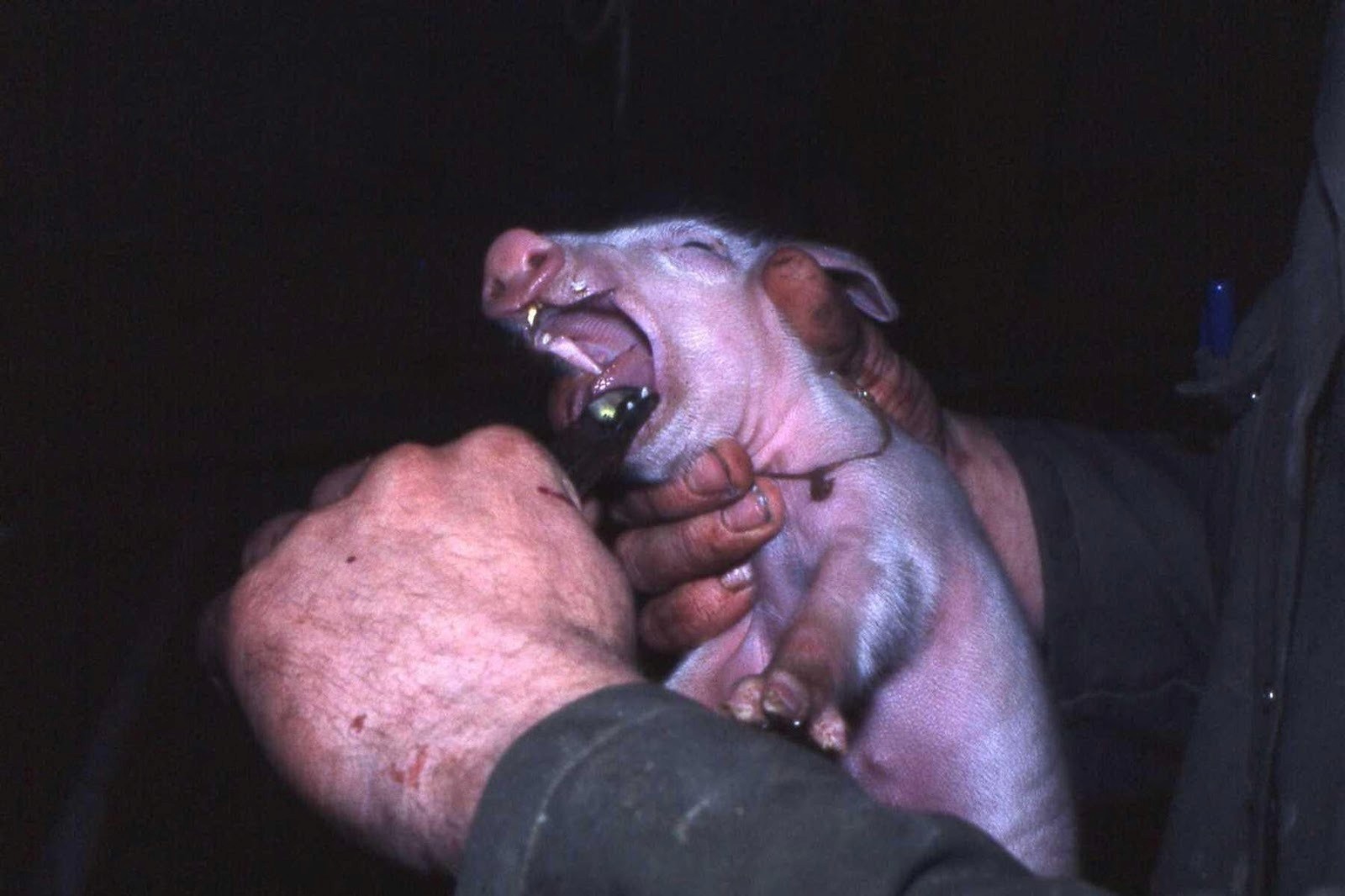
Teeth Removal Image Courtesy of NADIS
There are no branches. She paces in her tiny space (two steps forward, two steps back) frantically. She cannot fulfill the drive. It consumes her. Research shows her cortisol levels are elevated, her stress hormones surging. She is in psychological agony.
When she is close to giving birth, she is moved to a farrowing crate. This crate is similar in size
but has additional metal bars along the sides to prevent her from rolling over and crushing her piglets. The bars confine her even more tightly than before.
She gives birth to 12 piglets. She cannot move to lie down carefully. When exhaustion overtakes her and she collapses, two piglets are crushed beneath her weight. She hears them squeal. She hears them die. She cannot move to avoid them. She cannot reach them. She can only lie there, pressed against metal bars, while her offspring die inches away.
She is intelligent enough to know something is wrong. She is powerless to stop it.
The surviving piglets nurse. She is unable to interact with them beyond allowing them to feed. The crate prevents her from nuzzling them, moving with them, protecting them in any meaningful way. After three weeks, workers come and take them. All of them. She calls for them. She cries for days, her voice growing hoarse. They do not come back. No one comes.
Within days, she is artificially inseminated again. The cycle begins again. Pregnancy. The frantic, unfulfillable drive to build a nest. Birth in the farrowing crate. Piglets crushed. Piglets taken. Re-impregnation.
She will go through this four to six times over the next 2.5 years. Four to six pregnancies. Four to six litters of piglets, some crushed, all taken from her. Four to six times experiencing the biological drive to build a nest and being unable to fulfill it. Four to six times calling for her babies until her voice gives out and learning, again, that calling achieves nothing.
She is intelligent enough to remember. Intelligent enough to anticipate. When workers approach in the later pregnancies, she knows what is coming. She knows her piglets will be taken. She knows she cannot stop it. That knowledge does not reduce her distress. It amplifies it.
After her fourth litter, her body begins to break down. Her litter size is smaller. She develops a leg injury from lying on concrete for years. She is classified as no longer productive. She is loaded onto a truck with other cull sows and transported to slaughter.
The journey takes several hours. It is summer. Pigs have no sweat glands. The truck is not climate-controlled. The heat builds. She is panting, her body temperature rising. Some pigs in the truck die from heat stress before they reach the slaughterhouse. She survives.
At the slaughterhouse, she is unloaded and moved through a series of pens toward the stunning area. She can smell blood. She can hear sounds from the processing area: machinery, the impact of bolt guns, the screams of other pigs. Her heart rate spikes. She is afraid, though she does not know exactly what she is afraid of. Only that something terrible is coming.
She is moved into a restraint area where she and nine other pigs are loaded into a metal gondola. The space is tight. She is pressed against other pigs, their bodies touching, all of them stressed, some vocalizing. The metal gate closes behind her.
The gondola begins to descend into a pit. At first, nothing seems wrong. She is confused by the
movement but not yet in distress. Then she begins to breathe CO₂.
Within seconds, the physiological effects begin. CO₂ triggers acute respiratory distress in mammals. It is not a gentle loss of consciousness. It is suffocation while fully conscious. She begins gasping for air. She opens her mouth wide, trying to breathe, but every breath brings more CO₂. The gas forms carbonic acid in her lungs and nasal passages, causing a burning sensation. She begins vocalizing, not a normal pig sound but a high-pitched, distressed squealing. She tries to escape, climbing over the other pigs, biting at the metal bars of the gondola. Some of the other pigs urinate in panic. She does too.
The gondola descends further. The CO₂ concentration increases. She becomes more frantic. She is suffocating. Her brain is being deprived of oxygen. She thrashes violently. She slams her body against the gondola walls. Her squealing reaches a peak, a clear expression of terror and agony.
Carbon Dioxide Stunning Image Courtesy of Four Paws
She understands, in whatever way a pig understands, that she is dying.
After approximately 30 seconds (though it feels infinitely longer to her), the oxygen deprivation begins to affect her consciousness. Her movements become uncoordinated. She begins to collapse. But she is still conscious, still aware, still in distress. She convulses, her legs kicking, her body twitching, even as she lies on her side unable to stand.
After approximately 50 seconds of breathing high-concentration CO₂, she finally loses consciousness.
The gondola continues to descend, submerging her completely in the CO₂ for another 30 to 60 seconds to ensure loss of brain function. Then the gondola rises, carrying her unconscious body back up to the upper level.
She is dumped out of the gondola and shackled by one hind leg. She is hoisted onto a moving chain and her throat is cut. She is unconscious for this. Most pigs are. Some are not. Some regain consciousness during the shackling process because CO₂ stunning does not kill, it only renders unconscious, and consciousness can return within 30 to 60 seconds if the animal is not bled quickly. Video footage from slaughterhouse investigations shows pigs on the bleed-out chain who are clearly conscious: moving their heads, blinking, attempting to lift their bodies.
She remains unconscious. Her throat is cut and she bleeds out over several minutes. Her heart stops. She is dead.
This was her life: Three days old, mutilated without anesthesia. Three weeks old, torn from her mother. Six months old, confined in a crate where she could not turn around for 2.5 years.
Repeatedly impregnated. Repeatedly giving birth in conditions where some of her piglets were crushed. Repeatedly having her piglets taken from her. Her body used until it broke down. Then transported in summer heat to a slaughterhouse where she was suffocated with CO₂ for 50 seconds while fully conscious before finally losing consciousness and being killed.
She was as intelligent as a dog. As intelligent as a three-year-old child. She could have solved puzzles, recognized herself in a mirror, formed deep social bonds, experienced joy and curiosity and love. Instead, she experienced this.
Not because of cruelty or sadism, but because of efficiency. Because pork needs to be cheap. Because consumers want bacon for $4.99 per pound.
Her intelligence did not save her. It did not earn her better treatment. It just meant she suffered more completely, more consciously, with a fuller understanding of what was being done to her.
She remembered the previous litters being taken. She anticipated it happening again. She knew, in whatever way a pig knows, that something was profoundly wrong with her existence. That knowledge did not reduce her suffering. It amplified it.
That is what intelligence got her.
This is standard practice. This is legal. This is how pork is produced. And it happened to her, and to 1.5 billion other pigs last year, and it will happen to 1.5 billion more this year, and every year after that until the system changes.
She was one. One in 1.5 billion.
Captive-bolt stunning
A cow enters the stunning box. A narrow metal chute that restrains her movement and positions her head for the captive-bolt gun. She can smell blood from earlier slaughter. She can hear sounds from the processing area beyond: machinery, workers, the impact of bolt guns on skulls. She is afraid. Her heart rate is elevated (studies show pre-slaughter heart rates in cattle can exceed 120 bpm, more than double their normal resting rate).
A worker positions the captive-bolt gun against her forehead. The gun fires a metal rod at high velocity into her brain. If positioned correctly, the bolt penetrates the skull, destroys the cerebral cortex, and renders her instantly unconscious. She collapses immediately, her legs folding, her body dropping to the floor of the stunning box.
But positioning is critical, and it does not always work correctly. Reasons for failure include:
The cow moves her head at the moment of firing
The cow's skull is thicker than average or has abnormal anatomy
The worker is fatigued (workers often process hundreds of cows per day) and misplaces the gun
The bolt gun is not properly maintained and fires with insufficient force
The cow is restless or agitated, making accurate placement difficult
When stunning fails, the cow does not lose consciousness. The bolt may penetrate the skull but miss the brain. It may penetrate only partially. It may hit the wrong area of the brain. The cow is injured but conscious. She is stunned in the sense of being disoriented and in shock, but she is not unconscious.
Video footage from slaughterhouse investigations shows what this looks like: a cow shot with the bolt gun who does not immediately collapse. She stumbles. She tries to back out of the stunning box. Her eyes are wide. Blood is pouring from the wound in her skull. The worker reloads the gun and shoots again. Sometimes a third shot is necessary. The animal is aware, in pain, and terrified.
Studies and audits of stunning efficacy in cattle slaughterhouses show highly variable results. Well-run facilities using properly maintained equipment and trained workers achieve stun success rates of 95-99%. Poorly run facilities, or facilities processing particularly stressed or difficult cattle, can have failure rates of 5-10% or higher. Temple Grandin, a prominent animal welfare consultant to the meat industry, has published audits showing that some facilities have
stun failure rates above 10%.
Bolt Stunning Image Courtesy of Peta
At a facility processing 300 cattle per day, even a 1% failure rate means 3 cattle per day are not properly stunned on the first shot. Over a year, that's over 1,000 cattle at that single facility experiencing the trauma of multiple bolt gun shots. Scale this to the approximately 300 million cattle slaughtered annually worldwide, and even a 1% failure rate translates to 3 million cattle per year not properly stunned on the first attempt.
After stunning (successful or not), the cow is shackled by one hind leg, hoisted onto a moving chain, and her throat is cut. Blood pours from the severed arteries. She is supposed to be unconscious or dead at this point. But some cows regain consciousness during this phase.
Reasons include:
The stun was not deep enough (bolt did not penetrate sufficiently into the brain)
Too much time elapsed between stunning and throat-cutting (consciousness can return within 30-60 seconds if bleeding is not initiated quickly)
A cow who regains consciousness on the bleed-out line is in a situation of absolute horror. She is hanging upside down by one leg. Her throat has been cut. She is bleeding heavily. She cannot escape. She cannot stand. She cannot call for help. She is dying, but she is aware.
Video footage from slaughterhouse investigations shows this occasionally: a cow on the
bleed-out line who is clearly conscious. Her eyes are open and moving. Her head lifts. Her free legs kick. Sometimes she vocalizes—a sound like nothing else, a bellowing moan of pain and terror. Workers sometimes notice and cut the spinal cord to stop the movements (which are disturbing to watch), but this does not render the animal unconscious; it only paralyzes her while leaving her aware.
There are no reliable statistics on how often this happens. Industry sources claim it is rare. Investigations suggest it is more common than admitted. Even if it is genuinely rare, say, 0.1%
of cattle, that is still 300,000 cattle per year globally regaining consciousness while hanging upside down, throat cut, bleeding out. Three hundred thousand individuals experiencing perhaps the most terrifying death imaginable.
After bleeding (typically 3-5 minutes), the cow is moved to the processing area. Workers begin removing the hide and head. The animal is supposed to be dead. Video footage from investigations occasionally shows animals at this stage who are still alive: moving, blinking, responding to stimuli. These are called "late cutters" in industry jargon, animals who did not bleed out fast enough and are still alive when processing begins.
A cow who is skinned while alive experiences pain beyond description. The hide is removed by cutting through skin and connective tissue, peeling it away from muscle. If the animal is alive, she feels every cut, every tug on the skin, every moment of dismemberment. She cannot escape. She cannot scream (her throat is cut). She can only experience it until finally, mercifully, she dies from blood loss or shock.
What we know for certain is this: even when everything works perfectly, even when stunning is immediate and effective and death is as quick and painless as industrial slaughter can achieve, the animal still experiences fear, stress, and pain in her final hours. She is transported to an unfamiliar place. She smells blood. She hears other animals in distress. She is restrained. She dies. And this happens to approximately 300 million cattle per year, plus 70 billion chickens, plus
1.5 billion pigs, plus billions of other animals, every single year, year after year after year.
Why It Persists
The system continues not because people are cruel but because it is profitable and invisible.
Factory farming exists because it is efficient at converting inputs (feed, water, antibiotics, confined space) into outputs (meat, dairy, eggs) at the lowest possible cost. A chicken that takes 35 days to reach slaughter weight instead of 70 days requires half the feed, half the time, half the labor. A hen confined in a battery cage requires less space, less monitoring, less individual care than a hen with room to move. A pig in a gestation crate can be artificially inseminated on a precise schedule without the variability of natural breeding. These efficiencies translate directly to profit margins. The system is designed for throughput, not welfare.
The economic incentives are overwhelming. A farmer who provides more space, better conditions, or slower growth rates will produce more expensive products. Those products must compete with factory-farmed products in a market where most consumers choose based primarily on price. The structural pressure is always toward lower costs, which means higher density, faster growth, more confinement, less welfare. The race to the bottom is not a bug. It is the entire point.
But the system could not persist on economics alone if people actually saw what they were paying for. This is where the second factor becomes critical: invisibility. Factory farms are located in rural areas, far from population centers where most consumers live. They are
windowless buildings behind fences and "No Trespassing" signs. The industry fights viciously to keep cameras out. Many states have ag-gag laws that make it illegal to film inside agricultural facilities without permission, with penalties including fines and imprisonment. These laws exist explicitly to prevent the public from seeing what happens inside. When undercover investigators do capture footage, they face prosecution not for documenting animal cruelty (which is often legal) but for trespassing or violating ag-gag statutes. The message is clear: what happens inside these buildings is not your business, even though you are paying for it with every purchase.
The marketing actively obscures reality. Walk down the egg aisle at any supermarket and look at the cartons. Red barns. Green grass. Happy hens pecking at the ground in sunshine. The images are pastoral, comforting, nostalgic for a version of agriculture that has not existed at scale for half a century. The reality is windowless warehouses, wire cages, artificial lighting, and ammonia-saturated air. But the cartons do not show that. They show what consumers want to believe.
The labels are even worse. "Farm Fresh" sounds wholesome. It means nothing. There is no legal definition. All eggs come from farms, and "fresh" is subjective. "Natural" sounds healthy and humane. It also means nothing in the context of animal products. The USDA definition of "natural" for meat applies only to how the meat is processed after slaughter, not how the animal was raised. A chicken who spent her entire life in a battery cage, beak mutilated, bones broken, can be labeled "natural" as long as the meat contains no artificial ingredients after slaughter.
The label is technically accurate and functionally deceptive.
"Free-range" sounds even better. Surely these animals are roaming freely, living good lives. Not quite. The USDA requires only that birds have "access to the outdoors." Access can mean a small door at one end of a warehouse housing thousands of birds. Most birds never find the door. Those that do may find a small concrete pad outside, not pasture. The label says
"free-range." The reality is barely distinguishable from conventional confinement.
"Pasture-raised" is better, but even this label has minimal regulation. Some pasture-raised farms genuinely raise animals on pasture with space to move and engage in natural behaviors. Others use the term loosely, with minimal outdoor access and high stocking densities. Without
third-party verification, the label is just marketing.
"Organic" means the animals were not given antibiotics or growth hormones and were fed organic feed. It does not mean they were not confined. It does not mean they were not mutilated. It does not mean they had good lives. Organic chickens can still be debeaked. Organic pigs can still be castrated without anesthesia. Organic dairy cows still have their calves taken away. Organic beef cattle are still slaughtered. Organic is a production standard, not a welfare standard.
"Humanely Raised" appears on many labels with no legal definition whatsoever. It is pure marketing. Companies can print "humanely raised" on packaging regardless of actual conditions. Some companies create their own certification programs with impressive-sounding
names and official-looking logos. These programs are not regulated by any government agency. They are marketing departments giving themselves awards.
The only labels that mean something are third-party certifications like Certified Humane, Animal Welfare Approved, or Global Animal Partnership (which has multiple tiers, with higher tiers indicating better welfare). Even these certifications represent compromises. The standards are better than conventional factory farming, sometimes significantly better, but they still permit practices that cause suffering. Male chicks are still killed in egg production. Calves are still taken from mothers in dairy production. Animals are still slaughtered at a fraction of their natural lifespan. The certifications represent "better," not "good."
And here is the critical point: the vast majority of animal products sold in the United States (over 99% of meat, over 98% of eggs) come from factory farms with none of these higher-welfare certifications. The labels on most products are either meaningless ("natural," "farm fresh") or minimal improvements over the worst conditions ("cage-free"). The industry is not ignorant of this. The industry designed this. The labels exist to make consumers feel better about their purchases without requiring actual changes to production.
This is why the system persists. It is profitable, and it is invisible, and when people get glimpses of it, they are shown marketing images and reassuring labels that bear little resemblance to reality. The cognitive dissonance is built into the system. People can buy cheap meat and eggs, see pictures of happy animals on the packaging, read labels that say "humane" and "natural," and never confront what actually happened to the animal. The industry has made it easy to not think about it. And most people, if given a choice between confronting the reality of factory farming or simply not thinking about it, will choose the latter. It is easier. It is more comfortable. It requires no change in behavior.
The animals pay the price for that comfort. Seventy billion land animals per year. Every single one of them was a marketing success story. Every single one of them was purchased by a consumer who saw a label, believed a claim, and did not ask what happened behind the walls.
Antibiotic Resistance: Manufacturing a Crisis
Factory farming does not just harm animals. It threatens human health on a scale that makes individual food choices seem trivial by comparison. The primary threat is antibiotic resistance, one of the most serious public health challenges of the 21st century, and factory farming is one of its primary drivers.
Approximately 70 to 80% of all antibiotics sold in the United States are used in animal agriculture, not human medicine. The majority of antibiotics produced are not given to sick humans but to animals in factory farms. These antibiotics are not primarily used to treat disease. They are used for two other purposes: disease prevention (because animals in crowded, stressful, unsanitary conditions get sick easily) and growth promotion (because antibiotics make animals grow faster, for reasons not fully understood). The result is that millions of animals are
given low doses of antibiotics continuously, not because they are sick but because it is profitable.
This creates ideal conditions for the evolution of antibiotic-resistant bacteria. Here is how it works: When bacteria are exposed to antibiotics, most die. But some bacteria have random mutations that allow them to survive. Those bacteria multiply. Their offspring inherit the resistance. Over time, with repeated exposure to antibiotics, resistant strains become dominant. This is basic evolution, and it happens everywhere antibiotics are used. But factory farms are uniquely efficient at producing resistant bacteria because they combine several factors. Massive numbers of animals in close proximity allow bacteria to spread rapidly between individuals.
Continuous low-dose antibiotic use creates selection pressure for resistance without killing all bacteria. Poor sanitation and high-stress conditions weaken animal immune systems and allow bacteria to flourish. High turnover, with animals constantly being moved in and out, spreads bacteria to new populations.
The resistant bacteria do not stay on the farm. They leave through multiple pathways. Workers who handle animals and then return home carry bacteria on their skin, clothes, and in their respiratory tracts. Runoff from manure lagoons carries bacteria into groundwater and surface water. Airborne particles from facilities can carry bacteria for miles downwind. Meat from slaughtered animals can be contaminated with resistant bacteria and shipped to grocery stores across the country.
Once in the human population, these resistant bacteria cause infections that do not respond to standard antibiotic treatment. People die from infections that would have been easily treatable a generation ago. Urinary tract infections, pneumonia, bloodstream infections, surgical site infections: all of these can become untreatable if caused by resistant bacteria. A simple cut can become a death sentence. Routine surgeries become high-risk. Cancer treatments that rely on suppressing the immune system become impossible because there is no way to treat the infections that follow.
The World Health Organization has identified antibiotic resistance as one of the biggest threats to global health. The CDC estimates that in the United States alone, antibiotic-resistant bacteria cause at least 2.8 million infections and 35,000 deaths per year. Globally, the numbers are far higher. A 2016 study estimated that by 2050, antibiotic-resistant infections could kill 10 million people per year worldwide, more than cancer currently kills. This is not a distant hypothetical.
This is the trajectory we are on.
Not all of this is caused by factory farming. Overprescription of antibiotics in human medicine contributes. Poor infection control in hospitals contributes. Lack of new antibiotic development contributes. But factory farming is a major driver, and unlike some other factors, it is entirely unnecessary. The antibiotics given to animals are not saving lives. They are compensating for conditions that should not exist in the first place.
The industry has a response to this, naturally. They argue that they use different classes of antibiotics than those used in human medicine, so resistance does not transfer. This is false.
Bacteria do not care about drug classifications. Resistance genes can transfer between bacteria through several mechanisms, including horizontal gene transfer, where bacteria share genetic material directly like tiny genetic file-sharing networks. A bacterium that develops resistance to one antibiotic often develops cross-resistance to related antibiotics, including those used in humans. Multiple studies have documented identical resistant bacteria in both farm animals and humans, with genetic analysis confirming the farm origin. The industry knows this. They simply prefer to lie about it because the truth would require changing practices.
The industry also argues that they are reducing antibiotic use voluntarily. This is misleading to the point of being dishonest. In 2017, the FDA implemented rules prohibiting the use of antibiotics for growth promotion. Sounds progressive. Except the same antibiotics can still be used for "disease prevention" in groups of animals, with no requirement to document actual illness. The result: farmers simply relabel growth-promoting antibiotics as disease prevention antibiotics. The animals get the same drugs. The usage gets reported differently. Sales data shows no significant decline in overall antibiotic use in animal agriculture. The industry congratulates itself for making a change while changing nothing of substance.
Some countries have taken actual action. Denmark banned the use of antibiotics for growth promotion in 1999 and restricted their use for disease prevention. The result: antibiotic use in animal agriculture dropped by more than 50%, with no negative impact on animal production or farmer income. Turns out the animals were not healthier because of antibiotics; they were sick because of the conditions. When Denmark improved conditions (more space, better sanitation, lower stocking densities), antibiotic use became less necessary. The industry claimed this would be economically devastating. Denmark proved them wrong. Production continued. Farmers adapted. The apocalypse did not arrive.
The United States has not followed Denmark's example. The lobby groups are too powerful, the profit margins too important, the political will too weak. American exceptionalism apparently includes being exceptionally bad at learning from other countries' successes. So the system continues, breeding resistant bacteria, sending them into the human population, rendering antibiotics ineffective, killing tens of thousands of people per year.
This is not a hypothetical future threat. This is happening now. People are dying now from infections that are resistant to treatment because factory farms are breeding resistant bacteria to compensate for conditions that prioritize profit over welfare. The animals suffer in crowded, filthy conditions. Then humans die as a consequence of those conditions. Everyone loses except the companies profiting from the system.
When someone eats factory-farmed meat, they are not just funding animal suffering. They are funding a public health crisis that will eventually affect them, their children, their community.
Antibiotic resistance does not care about individual food choices. It spreads. It compounds. It gets worse every year the system continues.
The irony is darkly fitting: the same system that treats animals as production units, cramming them together with no regard for their welfare, is creating conditions that will eventually treat
humans the same way. When antibiotics stop working, humans become as vulnerable as the animals we confine. Perhaps that is justice of a sort. Or perhaps it is just another layer of suffering in a system that seems designed to maximize it.
The Environmental Bill Comes Due
Factory farming does not stay contained within the walls of the facilities, or even our own bodies upon consumption. The environmental damage radiates outward, affecting ecosystems, water supplies, air quality, and climate stability. The animals suffer inside. The rest of the world suffers outside.
Factory farms produce enormous quantities of waste. A single industrial pig farm with 10,000 animals produces as much fecal waste as a city of 25,000 to 50,000 people. The difference: the city has a sewage treatment system. The pig farm has manure lagoons. Manure lagoons are exactly what they sound like: massive open-air pits filled with liquefied animal waste. They are unlined or poorly lined. They leak. They overflow during heavy rain. They rupture. When this happens, millions of gallons of waste containing nitrogen, phosphorus, pathogens, antibiotics, and hormones flow into nearby waterways.
In 1995, a manure lagoon in North Carolina ruptured and spilled 25 million gallons of hog waste into the New River. Fish died by the millions. The contamination spread for miles. The smell was described as unbearable for weeks. This was not an isolated incident. It was simply the largest and most publicized. Lagoons rupture regularly. In 2018, Hurricane Florence caused dozens of manure lagoons in North Carolina to overflow, flooding nearby communities with fecal waste.
Residents waded through water contaminated with animal excrement. Their homes were ruined. Their wells were contaminated. The industry called it an unfortunate natural disaster. The residents called it a predictable consequence of building massive waste lagoons in flood-prone areas.
NC Lagoons Held Billions of Gallons of Hog Feces. I
Image Courtesy of Democracy Now!
The nitrogen and phosphorus in manure cause eutrophication in waterways. Algae blooms feed on the nutrients and grow explosively, covering the water surface. When the algae die, they decompose, consuming oxygen in the water. The oxygen levels drop. Fish and other aquatic life suffocate. The result is dead zones: areas where nothing can survive. The Gulf of Mexico has a dead zone the size of New Jersey, caused primarily by nutrient runoff from industrial agriculture, including factory farms. Every summer, the dead zone expands. Every summer, thousands of square miles of ocean become uninhabitable. The shrimp die. The fish die. The crabs die.
Commercial fishermen lose their livelihoods. The industry that caused it continues operating.
Communities near factory farms have contaminated wells. The water smells of feces. It contains nitrates at levels that cause health problems, particularly for infants. Nitrates interfere with oxygen transport in the blood, causing "blue baby syndrome," where infants turn blue and can die from oxygen deprivation. Rural communities, often poor, often communities of color, drink contaminated water because they have no alternative. They cannot afford to move. They cannot afford bottled water for all their household needs. So they drink the contaminated water and hope they do not get sick.
The air pollution is equally severe. Factory farms release ammonia, hydrogen sulfide, and particulate matter into the air. The smell is not just unpleasant; it is dangerous. Hydrogen sulfide is toxic at high concentrations, causing respiratory problems, headaches, nausea, and at extreme levels, death. Workers in confined animal facilities have higher rates of respiratory disease than the general population. Communities downwind of factory farms report increased rates of asthma, particularly in children. Studies have documented elevated rates of respiratory infections, reduced lung function, and decreased quality of life among people living near concentrated animal feeding operations.
The ammonia released by factory farms contributes to the formation of fine particulate matter in the atmosphere. These tiny particles, smaller than 2.5 micrometers, can be inhaled deep into the lungs and enter the bloodstream. They cause cardiovascular disease, respiratory disease, and premature death. A 2021 study estimated that emissions from animal agriculture cause approximately 17,900 deaths per year in the United States from air pollution. That is nearly 18,000 people per year dying because factory farms release pollutants into the air. Not from eating the products. Just from breathing the air near the facilities.
People living near factory farms have higher rates of respiratory infections, higher rates of asthma, lower quality of life due to the constant smell and inability to open windows or spend time outdoors, and lower property values. Who wants to buy a house near a facility that smells like a sewer and contaminates the air and water? Schools near factory farms have higher absenteeism because children get sick more often. These effects are not evenly distributed.
Factory farms are disproportionately located near low-income communities and communities of color, making this an environmental justice issue as well as an animal welfare issue and a public health issue. The pattern is consistent: concentrate the suffering among those with the least power to resist.
Then there is climate change. Factory farming is a significant contributor to greenhouse gas emissions. Livestock production is responsible for approximately 14.5% of global greenhouse gas emissions, comparable to the entire transportation sector. Every car, truck, plane, and ship on Earth, combined, produces about the same emissions as raising and killing animals for food.
The emissions come from multiple sources. Ruminants like cows produce methane as a byproduct of digestion. Bacteria in their stomachs break down plant matter and produce methane, which the cows release through belching and flatulence. Methane is a greenhouse gas approximately 25 times more potent than carbon dioxide over a 100-year period. A single cow can produce 200 to 500 liters of methane per day. With approximately 1 billion cattle globally, the numbers add up quickly.
Decomposing manure in lagoons produces both methane and nitrous oxide. Nitrous oxide is approximately 300 times more potent than carbon dioxide as a greenhouse gas. The manure lagoons are essentially greenhouse gas factories, sitting open to the atmosphere, releasing emissions continuously.
Growing feed for animals requires enormous land area, fertilizers (which produce nitrous oxide when applied to soil), and fossil fuels for machinery and transportation. Approximately 77% of global agricultural land is used for livestock, either for grazing or for growing feed. But livestock provides only 18% of global calories and 37% of global protein. This is an extraordinarily inefficient use of land. The same land used to grow crops for animal feed could grow crops for human consumption and feed far more people using far fewer resources.
To create more land for livestock grazing and feed production, forests are cleared. The Amazon rainforest, one of the most important carbon sinks on the planet, is being destroyed at an accelerating rate, primarily for cattle ranching and soy production. Most soy grown globally is fed to animals, not humans. The industry markets plant-based diets as requiring soy and therefore causing deforestation. The reality is precisely inverted: animal agriculture is the primary driver of soy production and deforestation. Clearing forests releases stored carbon into the atmosphere and eliminates the trees that would have continued absorbing carbon. It is a double hit: adding emissions and removing the natural systems that could absorb those emissions.
The argument is sometimes made that grass-fed or pasture-raised livestock are better for the environment than factory-farmed livestock. This is only partially true and mostly misleading. Pasture-raised animals produce less pollution runoff because their waste is distributed over larger areas rather than concentrated in lagoons. They require fewer antibiotics because they are not confined in conditions that breed disease. These are improvements. But pasture-raised animals also require far more land because they are not confined, which means more land
taken from other uses, including potential forest or wildlife habitat. They produce just as much methane from digestion, and they grow more slowly, which means more lifetime emissions per animal. More importantly, pasture-raised systems cannot scale to current demand. There is not enough land on Earth to raise 70 billion land animals per year on pasture. The math does not work. The only way pasture-raised systems work at scale is if meat consumption decreases dramatically. Which is precisely the point. The real solution is not switching to grass-fed beef. It is eating far less beef.
Factory farming is also extraordinarily inefficient at converting resources into food. It takes approximately 1,800 gallons of water to produce one pound of beef. For comparison, it takes 108 gallons of water to produce one pound of corn. That is more than a 16-to-1 ratio. In a world where freshwater is increasingly scarce, where droughts are becoming more frequent and severe, where millions of people lack access to clean water, using thousands of gallons of water to produce a single pound of meat is a luxury that cannot be sustained.
Similarly, it takes approximately 10 pounds of feed to produce 1 pound of beef. That 10 pounds of feed is itself calories that could have fed humans directly. Instead, those calories are fed to a cow, and a fraction comes back as meat. The system is designed to be inefficient because the goal is not feeding people efficiently. The goal is producing meat profitably. Factory farming is a system that takes edible crops, feeds them to animals, and gets back a fraction of the calories. In a world where nearly 1 billion people are chronically undernourished, where children die from malnutrition, this is not just inefficient. It is obscene. We are taking food that could feed people and using it to raise animals in suffering so that people in wealthy countries can eat meat at every meal.
The environmental costs of factory farming radiate outward in every direction. Water pollution, air pollution, climate change, deforestation, resource depletion. The system damages ecosystems, harms human health, destabilizes the climate, and does it all while producing food less efficiently than alternatives. The animals suffer inside the facilities. The environment suffers outside them. Future generations will suffer from the climate consequences. And all of it continues because it is profitable in the short term for the companies running the system.
How This Ends
A system embedded in economics, politics, culture, and habit. A system that has been optimized for efficiency and profit with no regard for welfare or consequences. Changing it seems impossible.
It is not. It is difficult, but it is not impossible. And there are multiple pathways forward, each requiring different skills, different commitments, different strategies.
The most direct action is individual: stop funding the system. Every purchase of factory-farmed animal products is a vote for the system to continue. Every decision not to purchase those products is a vote for alternatives. This does not require perfection. It does not require veganism, though veganism is the most ethically consistent position if one believes animals have moral value. It requires reduction. Eating less meat, dairy, and eggs means fewer animals bred into the system. Choosing plant-based alternatives means funding the development of better alternatives. Choosing products from higher-welfare sources, when available and affordable, means creating market pressure for better conditions.
Some people will argue that individual choices do not matter, that the system is too large, that one person's actions are a drop in the ocean. This is mathematically false. If one person eats an average American diet, they will consume approximately 7,000 animals over their lifetime. Most of them fish and chickens, but the number includes cows and pigs as well. If that person reduces their consumption by even 50%, that is 3,500 fewer animals bred into the system. If 1,000 people make the same choice, that is 3.5 million animals. If 1 million people make that choice, that is 3.5 billion animals. Individual choices compound. The argument that individual action does not matter is an excuse to avoid responsibility.
More importantly, individual choices influence others. Social norms change when enough individuals change their behavior. A person who reduces their meat consumption talks about it, shares plant-based recipes, brings plant-based dishes to gatherings, normalizes the choice for others. They make it easier for the next person to make the same choice. This is how cultural shifts happen: one person at a time, compounding, building momentum until what was once unusual becomes common and what was once common becomes unacceptable.
But individual action is necessary, not sufficient. The system must change at the structural level. This requires legal reform, and legal reform requires advocates willing to do the work. Ag-gag laws must be repealed. The public has a right to know how their food is produced. Undercover investigations have been the primary source of information about factory farming conditions, and criminalizing those investigations serves only to protect the industry from accountability.
Organizations like the Animal Legal Defense Fund are fighting these laws in court, and they need lawyers, paralegals, and legal researchers willing to work on these cases.
Minimum welfare standards must be established and enforced. Battery cages should be banned. Gestation crates should be banned. Routine mutilations without anesthesia should be banned. Stunning methods that cause prolonged suffering, like CO₂ for pigs, should be replaced with less aversive alternatives. These changes will not happen without pressure. They require advocacy organizations running campaigns, conducting investigations, lobbying legislators, and organizing public pressure. Organizations like The Humane League, Mercy For Animals, Animal Equality, and Compassion in World Farming are doing this work, and they need campaigners, organizers, communications specialists, and researchers.
Antibiotic use in animal agriculture should be restricted to treatment of diagnosed illness, with prescriptions required and records audited. Denmark has already done this successfully. The United States has no excuse for not following. This requires pressure on the FDA and USDA,
which requires advocates who understand policy, can analyze data, and can make compelling cases to regulators. Organizations like the Center for a Livable Future at Johns Hopkins and the Pew Charitable Trusts work on these issues and need policy analysts and public health researchers.
Subsidy reform is essential. The U.S. government subsidizes animal agriculture through multiple pathways: direct payments to farmers, subsidized crop insurance, subsidized feed prices (corn and soy are heavily subsidized, and they are the primary feed for factory-farmed animals), and programs that purchase surplus animal products for distribution in schools and food assistance programs. These subsidies make factory-farmed meat artificially cheap. If the subsidies were redirected to plant-based agriculture or alternative proteins, the economics would shift rapidly.
Factory-farmed meat would cost what it actually costs to produce, accounting for environmental damage, public health impacts, and animal suffering. Plant-based foods would be cheaper in comparison. Consumer behavior would shift. This requires political advocacy, which requires people willing to work in politics, either as staffers for elected officials or as lobbyists for advocacy organizations.
Transparency requirements would change consumer behavior immediately. Mandatory labeling should indicate how animals were raised: confined or pasture, with or without routine antibiotics, stunning method used at slaughter. Include photographs or video from the actual facilities. Let consumers see what they are buying. The industry resists this because transparency would damage demand. They know that if people saw inside factory farms, many would stop buying the products. That is precisely why transparency is necessary. Consumers cannot make informed choices without information. Advocacy for labeling requirements requires lawyers, policy specialists, and communications experts who can make the case to regulators and the public.
Investment in alternatives could make factory farming obsolete. Governments and private investors should fund research and development of alternative proteins: plant-based meats that taste indistinguishable from animal meat, cultivated meat grown from cells without raising and slaughtering animals, and fermentation-based proteins that use precision fermentation to produce animal proteins without animals. These technologies are improving rapidly but need continued investment to achieve price parity with conventional meat. When alternatives are cheaper, tastier, and more convenient than factory-farmed products, the system will change quickly. Not because of ethics, but because of economics. Companies developing these alternatives need scientists, engineers, food technologists, marketers, and business strategists. This is a career path that could directly replace the need for factory farming.
For people who want to dedicate their professional lives to this issue, there are multiple pathways. Direct advocacy organizations need investigators willing to enter facilities and document conditions, knowing they may face prosecution. They need campaigners who can organize pressure campaigns targeting corporations and legislators. They need communications specialists who can translate complex issues into compelling narratives that change public opinion. They need researchers who can analyze data, evaluate interventions, and provide evidence-based recommendations.
Legal advocacy organizations need lawyers willing to work on strategic litigation, challenging ag-gag laws, prosecuting animal cruelty cases, and establishing legal precedents for animal protection. They need people who understand that progress in animal welfare will be won in courtrooms as much as in legislatures.
Research and policy organizations need analysts who can study the animal agriculture system, evaluate the effectiveness of different interventions, model the impacts of policy changes, and provide recommendations to advocates and policymakers. Organizations like Sentience Institute and Rethink Priorities are doing this work and need people with research skills, data analysis skills, and the ability to communicate complex findings clearly.
Alternative protein companies need people across disciplines. Scientists to improve the taste and texture of plant-based meats. Engineers to scale up production. Food technologists to develop new products. Marketers to convince consumers to try alternatives. Business strategists to compete with established animal agriculture companies. This sector is growing rapidly and offers opportunities to work on solutions that could replace factory farming entirely rather than just reforming it.
Journalism and media offer another pathway. Investigative journalists can expose factory farming practices to the public. Documentary filmmakers can create films that change how people think about animal agriculture. Writers can tell the stories of individual animals, making the statistics feel real. Undercover investigations and long-form journalism have been critical in changing public opinion, and there is always need for more people willing to do this difficult, often dangerous work.
Academia offers opportunities to study animal welfare from multiple angles. Researchers in animal science can develop better welfare metrics and study the impacts of different housing systems. Veterinary researchers can investigate pain and suffering in farm animals and develop better pain management. Philosophers can examine the ethical implications of animal agriculture and make arguments for moral consideration of animals. Sociologists can study how social norms around meat consumption change. Economists can analyze the true costs of factory farming, including externalities like environmental damage and public health impacts. All of this research informs advocacy and provides the evidence base for policy change.
Politics and government offer pathways for people willing to work within the system. Staffers for elected officials can push their bosses to support animal welfare reforms. People working in agencies like the USDA, FDA, or EPA can push for better enforcement of existing laws and development of new regulations. This work is often frustrating, progress is slow, and compromises are frequent. But regulations matter. Enforcement matters. Having advocates inside the system matters.
The work is often difficult and emotionally taxing. Watching footage from factory farms damages people. Reading about animal suffering day after day takes a toll. The progress is slow, measured in years and decades rather than days and weeks. Failures are frequent. The opposition is well-funded and politically connected. Burnout is common. But progress is
possible. Battery cages have been banned in the European Union. Gestation crates have been banned in multiple U.S. states. Major food companies have committed to sourcing only
cage-free eggs. Consumer demand for plant-based alternatives has grown exponentially in the last decade. Beyond Meat and Impossible Foods have made plant-based burgers that taste remarkably like beef and are available in fast-food restaurants and grocery stores nationwide. Cultivated meat companies are beginning to bring products to market. The issues are entering mainstream discourse in ways that would have been unthinkable 20 years ago.
The system persists, but it is not inevitable. It exists because it is profitable and because people allow it to exist. It continues because consumers fund it with purchases and tolerate it with silence. It can be changed. The change will not be easy. It will require sustained effort from many people working on many different strategies simultaneously. It will require individual action, advocacy, legal reform, political pressure, technological innovation, cultural shifts, and systemic change. But it is possible.
The animals cannot advocate for themselves. They cannot vote, lobby, protest, or sue. They cannot tell their stories. They are entirely dependent on humans to recognize their suffering and choose to act. Seventy billion land animals per year are bred, confined, mutilated, and killed in this system. Each one is an individual with the capacity to suffer, the desire to avoid pain, and an interest in continuing to live. The hen in the battery cage, the pig in the gestation crate, the cow crying for her calf: they are not statistics. They are beings whose entire lives consist of suffering imposed on them for human benefit.
The question is not whether they suffer. The evidence is overwhelming. The question is not whether alternatives exist. They do. The question is whether their suffering matters enough to change behavior. Whether convenience and habit and taste preferences matter more than their entire lives. Whether humans are capable of recognizing that the capacity to suffer creates moral obligations, and that those obligations extend to beings who cannot advocate for themselves.
That is a question each person must answer. But the answer reveals something essential about who we are and what we value. It shows us what we are willing to tolerate, what we are willing to ignore, what we are willing to pay for.
This is exactly who we are: a species that will torture billions rather than inconvenience ourselves.